


















Safari
Open
10am-3.40pm (subject to change without notice). Note: the free safari bus cannot be booked in advance.
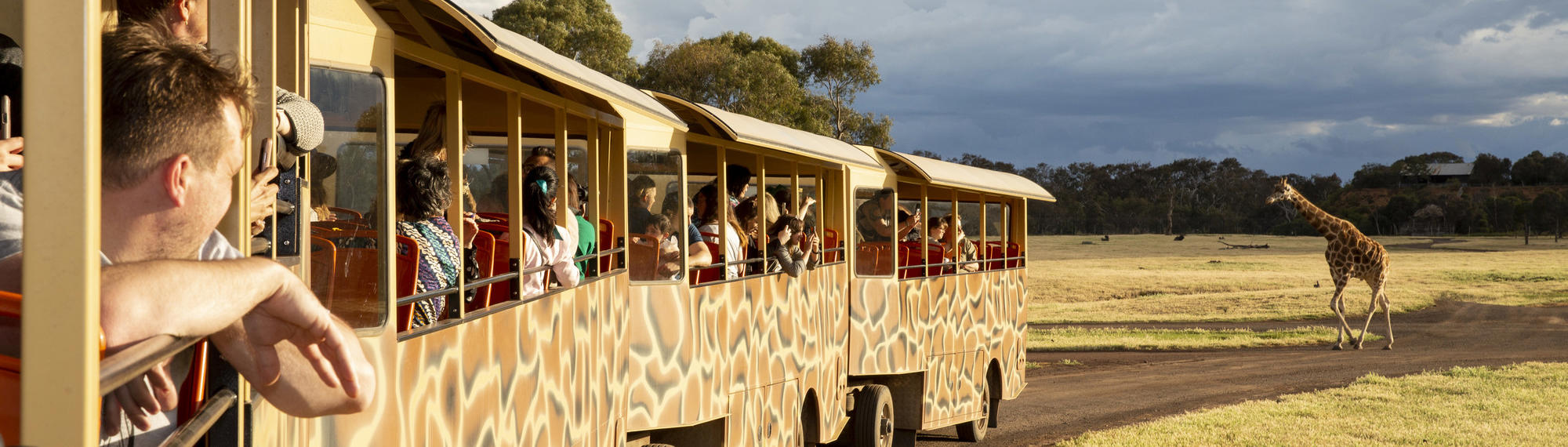
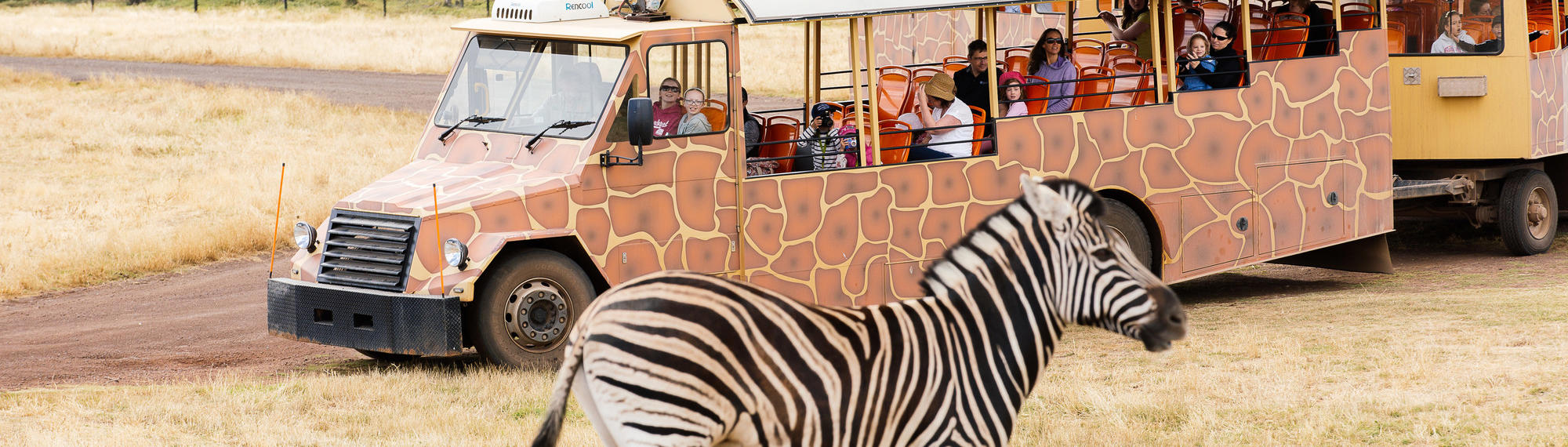
A visit to our Zoo isn’t complete without a safari through the savannah! Climb aboard our big bus, and be transported through the open plains of Asia, North America and Africa to learn about some of the world’s most endangered species and our own conservation efforts. This all-ages, wheelchair accessible tour includes commentary from a safari guide and comes free with your admission price.
Waterbuck
Waterbuck are a large, robust species of antelope found in the Savannah grasslands, riverine forests and woodlands of Eastern Africa. Only the males have horns, which can grow as long as 100cm, and can be used against each other when Waterbuck fight over territories. Waterbuck are herbivores, mostly grazing on tall grass, as well as leaves from some trees and bushes.
Conservation Status
Least Concern
American Bison
American Bison are the largest land mammals in North America. Often confused with buffalo, they have large, distinguishing shoulder humps and thick winter coats. They live on grasslands, chewing cud (partly digested food) between morning and evening meals. In winter, the bison use their heads and hooves to find food beneath the snow.
Conservation Status
Near Threatened
Asian Wild Horse
Naturally skittish and shy, Asian Wild Horses, were on the brink of extinction. However, captive breeding programs have steadily increased their numbers. They’re social animals that graze, rest and play together. They share distinct friendships with each other, but have never been tamed by humans.
Conservation Status
Endangered
Blackbuck
The Blackbuck (or Indian Antelope) is one of the smallest and fastest members of the antelope family. Blackbucks were once widespread across the Indian subcontinent, but are now extinct in Bangladesh and Pakistan. Blackbucks are active during the day, grazing in grassland and lightly forested areas.
Conservation Status
Least Concern
Camel
One of the most efficient, resourceful and adaptable animals on the planet, the Dromedary, or one-humped Camel, can thrive in the most inhospitable environments. Camels were first imported here from Pakistan and India in the mid-1800s, and Australia now has the world’s largest population of wild camels.
Conservation Status
Least Concern
Eland
The Common Eland is the world’s largest antelope. Native to Africa, they cross great distances in search of food. They use their tightly-spiralled horns to pull twigs and branches into reach, but also forage for bulbs and roots. The Eland's social organisation is unusual—older males are solitary, while females and juveniles live together in large groups.
Conservation Status
Least Concern
Giraffe
Giraffes are sky-scraping mega-herbivores from Africa. They are thought to be one of the largest pollinators in the world, transferring seeds and plant matter from tree to tree on their noses, lips and tongues. Giraffes grow up to 5m tall. They move both legs on one side simultaneously when walking so they don’t trip!
Conservation Status
Vulnerable
Nyala
Nyala are a unique species of African antelope. Both males and females sport distinctive white spots and stripes on their sides. They're easy-going animals, and interact well with other species. When asserting dominance, males engage in a slow dance-like performance, instead of the more common sparring sessions.
Conservation Status
Least Concern
Ostrich
Though ostriches can’t fly, they use their wings like rudders to balance, steer, and change direction. They’re the world’s fastest flightless bird, and can reach speeds of up to 70km per hour. Males have black feathers; females have tan, honey-coloured feathers. Contrary to popular myth, the ostrich doesn't bury its head in the sand!
Conservation Status
Least Concern
Plains Zebra
The Plains Zebra has broad stripes that range from black to dark brown, and every one has a unique pattern. They’re social animals, forming family groups with a dominant stallion, several mares and foals. In the plains of Africa, zebras have many predators, so they’re restless, vigilant, and very vocal.
Conservation Status
Near Threatened
Scimitar-horned Oryx
Scimitar-horned Oryx have long, thin, finely-ridged horns that curve over their backs. ‘Scimitar’ comes from the curved swords historically used in Arabic countries. Once widespread in North Africa, the species was declared Extinct in the Wild by the IUCN Red List in 2000. Amazingly, thanks to dedicated conservation actions, they’re now classed as Endangered. They feed at night, when the desert plants they live on contain more water.
Conservation Status
Endangered
Southern White Rhinoceros
Predominantly found in South Africa, the Southern White Rhinoceros, or ‘square-lipped rhinoceros’, is the largest of the rhino families. They love to wallow in the mud, which has protective properties as a sunscreen, insect repellent and antiseptic. Their horns are made of keratin, the same as human fingernails and hair.
Conservation Status
Near Threatened