
























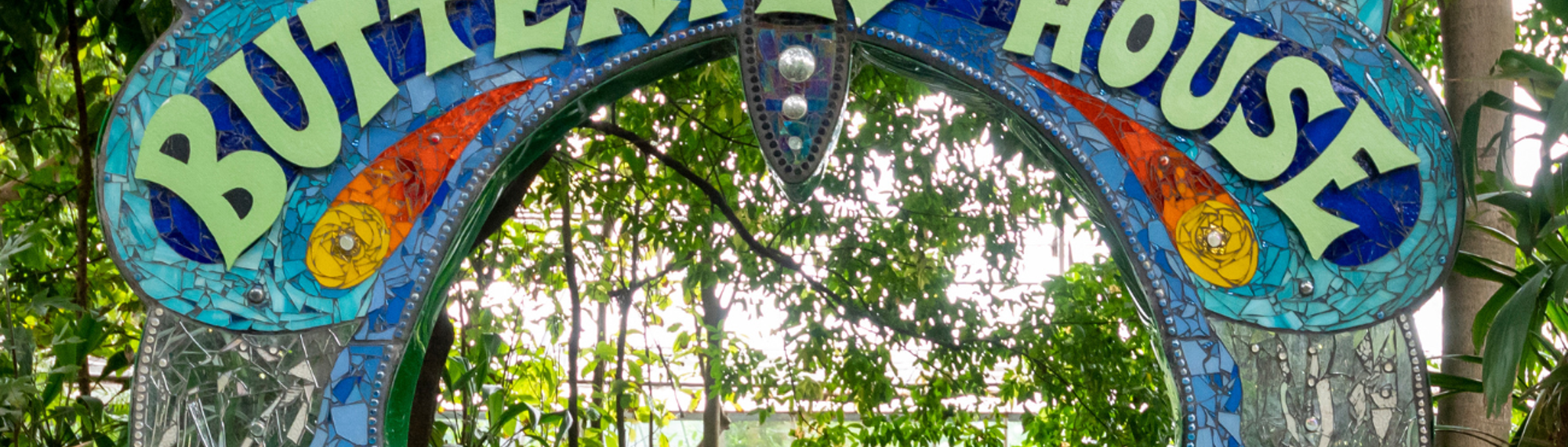
Flying high: Melbourne Zoo’s iconic Butterfly House turns 40
The year was 1985: Bob Hawke was Prime Minister, “We Are the World” was topping the charts and a little soap named Neighbours premiered on TV. It was also the year that Melbourne Zoo opened the glass doors to what would soon become a beloved oasis nestled in the inner-city.
“When the Butterfly House opened it was really innovative for the time,” says Kate Pearce, Melbourne Zoo’s Manager
of Birds and Invertebrates. "There wasn’t a big butterfly house like this in a public space like Melbourne Zoo. That
focus on insects hadn’t really been done in Australia before that.”
Forty years ago, the Butterfly House’s construction was “technically the most difficult task” Melbourne Zoo had
undertaken: a year-round Secret Garden showing species that may only live for a week or two.
In 2025, the Butterfly House is known as the home to over 22,420 butterflies per year, the largest being the Cairns
Birdwing (with a 20-25cm wingspan on the females) and the smallest being the Common Grass Yellow (approximately
40mm). 896,731 butterflies have been released in the glass house since 1985, with hundreds of visitors coming
through the door every day – less of them rocking parachute pants these days.
“It’s a really magical place. It’s serene, it’s beautiful,” says Pearce. “A lot of us have very special childhood memories
of coming here. In 1985 I was quite little and I came with my nana. I remember it really well. There are a lot of
people who came when they were little and are now brining the next generation along.”
Aside from being able to see 15 species of butterflies of various sizes and hues flutter from plant to plant like airborne
artworks, the Butterfly House is also known as a tropical paradise in the middle of (often cold and blustery) inner city
Melbourne. It’s perpetually balmy for those pollinators.
“The warmth in the Butterfly House is iconic,” says Pearce. “It’s a tropical environment, so we are mimicking
somewhere like Cairns. We want it between 28 and 30 degrees in the day and about 20 to 22 at night.”
Big systems back of house control the heating, cooling, ventilation and also humidity, which is at about 75 per cent all
year round. Forty years ago, shades on the roof of the house were manually operated, now a computer is able to
control a shade that reflects sun and disperses light without blocking out the sun.
Melbourne Zoo’s Horticulture team have filled the glasshouse with a diverse combination of different plant species
both for roosting and feeding. The butterflies lay eggs on the plants, the eggs hatch into caterpillars and are taken
back of house to develop.
“We have lots of flowering plants in here, so they have access to natural nectar,” says Pearce. Melbourne Zoo also
makes up about two litres of nectar every day to boost the supply.
About 61 new butterflies are released in the house every day. From 1985 Melbourne Zoo was breeding butterflies,
which Pearce explains was “quite unique’ for the time.